Showing posts with label 6c. Show all posts

Chapter 86: Delirious

Previous: Snap!

"We had to destroy democracy
in order to save it!"
"Under arrest?" cried the Minister. "Are you insane? I am a Minister! A member of the Cabinet! I am a part of the Government!! Do you understand??"

"Quite," said Slate.

"I cannot be arrested!" continued the Minister. "I cannot be jailed! I cannot be prosecuted! Do you not know anything?"

"I do know," said Slate calmly, "that no man's job title places him above the law."

"Ha!" replied the Minister, whose ashen face was becoming more florid with each passing second. "We make the law! We are the law! The law is ours! It is not to be used against us!"

Holmes, Slate, and I stared in disbelief as the handcuffed man carried on. Robinson, moving slowly, emerged from the bedroom and began to approach us. The Minister didn't seem to notice; he simply raged on.

"We're the government!" he shouted. "We make the law. So clearly we cannot break it. Do you see? Whatever we do is legal. It's legal because we do it. It's all very simple."

"I'm dreadfully sorry, Minister," replied Slate. "We have been instructed to apply the law equally. No exceptions. No exemptions."

"But the law is not yours!" exclaimed the Minister. "It's a tool of governance. Its function is to keep the peace, and that means protecting us, protecting the government. It is our tool, and it is to be used by us, not against us. Is that clear?"

"You can tell that to the jury," said Slate, "if the judge will permit it."

"Judge? Jury? What are you talking about?" continued the Minister. "I will never be prosecuted! Never, do you hear me? Never! No Crown attorney would ever do anything so daft!"

"We shall see about that," said Slate. "But first, you'd better come with me."

"What? How dare you?" demanded the Minister. "After what I've done to protect you? You don't understand a single thing that's happened, do you? We're in a war! Do you know that? Are you also trying to give aid and comfort to the enemy?"

"You see how they do it?" asked Holmes. "They tell a pack of lies to 'justify' starting a war, then they use the state of war to 'justify' telling more lies. In the process, they pervert the very idea of justice itself, as well as the democracy which they claim to protect."

"It's a struggle for power --
raw, unfettered, unambiguous."
"Justice?" cried the Minister. "Forget justice! We own it, and you can't have any. And what does democracy have to do with it? Democracy is an outdated concept. It's over. It doesn't apply here anymore, if it ever did.

"Politics is not a parlour game, gentlemen, nor is it a popularity contest. It's a struggle for power -- raw, unfettered, unambiguous. We need as much power as we can get in order to protect the nation. We had to destroy democracy in order to save it!"

"To protect the nation against what, exactly?" asked Holmes.

"Against Muslim fanatics," the Minister replied, "who would happily blow themselves to bits if they could take a plane full of innocent people with them!"

"Even if their plot was impossible?" asked Holmes.

"It doesn't make a damned bit of difference whether their plot was possible or impossible!" replied the Minister. "They hate us, and they were plotting to attack us. If their attack had succeeded, it would have killed tens of thousands of innocent people -- people who are still alive today, living productive lives, and paying taxes -- all because of us!

"Don't you understand? These fanatics are crazy! They have no respect for human life! We can't let them get their hands on our weapons of mass destruction! We don't want the next smoking gun to be a mushroom cloud! We can't let them blackmail us with all their oil! We must stay the course! Either you're with us or you're with the terrorists! Truth is the first casualty! Do you not see that?

"So we bomb and invade their countries -- so what? So we kill a few supposedly innocent people -- so what? Collateral damage. What difference does it make?

"We give the survivors an opportunity to create a viable democracy, with a strong and independent sovereign government controlled by a popularly elected legislature totally amenable to our interests. We put all that democratic infrastructure in place for them, and the ungrateful wretches refuse to take responsibility! Instead they hide in their caves and plot their revenge. Revenge against what? Our humanitarian intervention?

"And look what they do! They send imitation students halfway across the world to take pictures of football grounds and shopping centres while they communicate through coded email. Are we not supposed to arrest them? Are we not supposed to protect the community? Are we supposed to let them keep their bombs and their missiles and whatever else they have, so they can attack us again?"
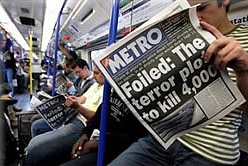
"Make the people tremble with fear,
and they'll give you what you want!"
"Again?" said Holmes. "They never attacked us for a first time! They didn't have any bombs or missiles, or anything else they could use to hurt us. It's becoming more and more obvious that you're running a monstrous protection racket. Make the people tremble with fear, and they'll give you what you want!"

"It's not our fault!" replied the Minister. "They only know what they want! They have no idea what they need! We had to enslave the people in order to free them! We had to take control!

"If a fanatical Muslim terrorist bombs your community, you won't care whether he had any bombs or not. You won't care whether his plan was viable. You won't even care if he was too stupid to tie his own shoes. You won't care about anything other than your dead and wounded friends and relatives. So that's why we do what we do -- to protect you from these Muslim fanatics, who would happily blow themselves to bits if they could take a plane full of innocent people with them!

"It doesn't matter if their plot was possible or not! They hate us, and they were plotting to attack us. If their attack had succeeded, it would have killed thousands of innocent people -- people who are still alive today, living productive lives, and paying taxes -- all because of us! You are free not to worry about the safety of your family, and it's all thanks to the government!

"Don't you understand? These fanatics are crazy! They have no respect for human life! We can't let them get their hands on our weapons of mass destruction! We don't want the next smoking gun to be a mushroom cloud! We can't let them blackmail us with all their oil! We must stay the course! Either you're with us or you're with the terrorists! Truth is the first casualty! Do you not see that?

"So we bomb and invade their countries -- so what? They hate us. We can't let them get their hands on our weapons of mass destruction! Don't you understand?

"So we kill a few supposedly innocent people -- so what? They have no respect for human life! We can't let them blackmail us with all their oil!

"If their attack had succeeded, it would have killed thousands of innocent people. You are free not to worry about the safety of your family, and it's all thanks to the government!

"We had to enslave the people in order to free them! We had to destroy democracy in order to save it! We had to take control to protect the nation! Don't you understand? They hate us. Do you not see that?"

"We'd better get him out of here, Bucky," said Scott Robinson. "He keeps saying the same things over and over."

"I think he's delirious," replied Buckingham Slate.

"They all are," added Sherlock Holmes.

Chapter 87: A Second Toast

Previous: Delirious

"To the world's first and finest
consulting detective, and to one of
his most impressive achievements!"
"Scott, call for a van and a couple of men, will you?" said Slate. "Wait in the street until they arrive, and then bring them up here. I'll guard the prisoner until you return."

"I'll be right back, Bucky," said Robinson, and he started for the door.

"I can't thank you enough, Mr. Holmes," said Slate when his colleague had disappeared down the stairs. "I've never seen anyone make so much progress on a case in such a short period!"

"Don't take it too seriously," said Holmes. "You came by at a good time, and we've had plenty of fortune along the way. The battle is not yet won, of course. Not by a long shot."

"Still," said Slate, "it's been a privilege, Mr. Holmes. You've done the lion's share of the work. Are you sure you want none of the credit?"

"My reputation is made, Bucky," replied my friend. "I don't need any more feathers in my cap. I don't want to deal with the press. I don't want to testify in court. I can count on you to do those things, and to do them well. But it will be hard work, no? It's a mixed blessing, but it's all yours."

"What feathers?" gasped the Minister. "What cap? You know what, Mr. Holmes? When I look at you, I don't see any cap, feathers or no. I see a double-crossing scoundrel. What a dirty little trap you set for me, you --"

"Zip it!" snorted Slate, and the Minister glared at him. "Let's get moving, Your Highness," he said. "I think I hear Robinson on the stairs."

"Travel safely, Bucky," said Holmes, extending his hand.

"And the same to both of you, gentlemen," returned Slate, shaking Holmes' hand, then mine. "Thanks again, and goodnight."

"I'm glad that's over!" I said when Slate and the Minister had left us. "Maybe I can sleep again."

"It's not over, Watson," said my friend. "We may think we've coaxed a clear confession out of him, but that doesn't guarantee a conviction. And even if this demented man is convicted of his part in the drama, what of all the others?

"The 'Liquid Bombers' may have been a hoax, but airport security will never be as it once was. The 'Easter Bombers' may have been another hoax, yet drones are bombing Pakistan almost every day, supposedly trying to eliminate such people, but often killing innocent families instead.

"Were the 'Easter Bombers' really trying to do us harm? Or were they simply looking for better education and employment prospects? We may never know, but relations with Pakistan have certainly taken a turn for the worse. Was that a justified response? Or was it prearranged and waiting for a pretext? We may never know that, either."

I sat quietly for several seconds, trying to absorb what my friend had said without being overwhelmed by my thoughts of the implications.

"Here's something I don't understand about what was done to Gareth," I said. "What was the purpose of the bondage and drag ruse? Who were they trying to fool?"

"Those are complicated questions, Watson," replied Holmes. "We may never know the answers. But consider this: Gareth Williams was as clean as they come. He didn't smoke, didn't gamble, didn't use drugs, didn't even drink, really. Maybe a glass of champagne every now and then if everyone else was having some, but otherwise nothing."

"Which makes perfect sense for a competitive cyclist," I said.

"Indeed," said my friend. "He had no spouse, no children, no dependents who could be threatened, or on whose accounts he could be blackmailed. As far as we know, he had no romantic partner who could be used in any way. The only aspect of his life, or of his personality, they could use against him was his interest in women's fashion."

"And you think that's what started it?" I asked.

"I do," said Holmes. "I'm not sure how it all unfolded, exactly. But I can't imagine they'd fail to attack such a vulnerable spot, especially given that there were few, if any, other 'soft targets' to choose from.

"I could spell out several possible scenarios illustrating how all the players could have been connected, and how the personal dynamics might have worked. But surely we have better things to do."

"I can think of one better thing to do right now!" I said. I poured cognac into two snifters and handed one to Holmes.

"To the world's first and finest consulting detective," I said, raising my glass to my companion, "and to one of his most impressive achievements!"

My friend drank with me, but he did not seem overjoyed. "I wouldn't overstate the success of the thing if I were you, Watson," he said. "They probably haven't even got him to the station yet. So many things could go wrong."

"Don't think like that, Holmes," I protested. "You're always so morose! Can't you just relax and enjoy the victory?"

"I wish I could, Watson," he replied. "Believe me, my friend, I wish I could. But I can't shake the feeling that we have done something horribly foolish."

"What do you mean?" I asked, recoiling from the idea.

"We have forgotten something," he answered, "or we have overlooked something. I don't know. But I don't feel right about it, I can tell you that."

He thought for quite some time before he spoke again.

"He won't spend a night in prison, Watson," he said, finally. "Slate and Robinson may be in terrible trouble. How could I have been so stupid?"

"Are you serious, Holmes?" I asked in dismay. "You don't think they can find a charge that will stick?"

"I don't think they will lay any charge at all," he replied. "We might even pick up the papers tomorrow morning and find out that none of this has ever happened."

"You're too pessimistic!" said I. "You have too many misgivings."

"No, Watson, I'm too realistic," said he. "And the more I think about it, the less I like it. I'll tell you what, my friend: If we read about the Foreign Minister being arrested by Buckingham Slate and Scott Robinson, in tomorrow morning's papers, I will buy you lunch at your favourite restaurant."

Chapter 88: Second Thoughts

Previous: A Second Toast

"You still have the keys!"
"Tomorrow will take care of itself," I sighed. "I'm exhausted, Holmes. I don't see how you can be otherwise. Perhaps your fatigue accounts for your attitude?"

"Not entirely, Watson," he replied. "But it might help to account for the errors in my calculations."

"What are you talking about, Holmes?" I asked.

"What have we failed to take into consideration?" he replied.

"I don't know," I said. "I'm sorry. I can hardly think straight. Who's that? Are you expecting anyone?"

We had both heard footsteps upon the stair. "No," said Holmes, moving toward the door, "but we will learn the identity of our visitor presently."

Saying these words, he opened the door -- just as Buckingham Slate was about to knock on it. "Come on in, Bucky," he said. "What brings you here again this evening?" Holmes caught my eye and shot a quick glance heavenward.

"We forgot something important," replied Slate, "and we had almost reached the station before we noticed. But we decided it would be best to turn back. I hope I'm not interrupting anything, sir."

"Not at all," said Holmes. "I am happy to see you. Is the Minister still in the van with Robinson and your colleagues?"

"Why, yes, sir," said Slate. "He's not going anywhere."

"Is he giving you any trouble?" asked Holmes.

"Not especially," said Slate. "He fell quiet as soon as we got him moving, sir."

"Good," said Holmes, "Now what did you forget?"

"Well, sir," said Slate with a chuckle, "we left the suitcase and our disguises behind, along with the microphones and the recording gear."

"Was there some urgency about any of that?" asked Holmes.

"No, sir," replied Slate. "All those things could have waited. Scott recorded the audio on a memory card, and he has it in his pocket, so that's not a problem. But the cuffs you slapped on the Minister? You still have the keys!"

"It's a good thing you decided to turn back," said Holmes with a chuckle. "It would have been embarrassing to arrive with a handcuffed prisoner and no keys to the cuffs. Please sit down for a minute, will you, Bucky?"

"It's fine, sir," replied Slate. "I've been sitting all night. If you'll just give me the keys, I'll get out of your hair."

"I am asking you to sit and talk with me for a minute," said my friend.

"Oh, I'm sorry, sir," said Slate, "I didn't, um, what is it?" he said, as he sat down on the couch.

"I forgot something too, Bucky," replied Holmes. "I think I made a bad mistake. But maybe it's not too late to fix it."

"What's that, sir?" asked Slate. "What did you forget?"

"Sometimes," replied Holmes, "the thrill of the hunt intoxicates the hunter, clouding his judgment and inducing errors he would normally avoid. It's been quite a hunt, and I was too eager to make an arrest. I allowed it to cloud my judgment."

"In what way, Mr. Holmes?" asked our guest.

"I forgot to take into account," replied my friend, "the fact that the 'operational direction' handed down to MI6 by the Foreign Office, and normally attributed to the Foreign Minister, is backed by some of the most powerful and ruthless men in the land. Do we really want to cross these people? And what result can we reasonably expect?

"The Minister raves like an utter lunatic," Holmes continued, "but in many respects, he's absolutely correct. For example, nobody wants to prosecute him. It might be the worst career move any Crown attorney could make.

"And nobody wants to admit it, but the government does own the law. The Prime Minister can make sure, through fair means or foul, that none of his friends will ever serve prison time, even if they somehow manage to get themselves convicted.

"The moment you drag the Minister into the station, the propaganda machine will shift into full spin. You and Robinson will be torn up in the press. Your reputations will be smeared endlessly. Your careers will be over. Your prospects will be worthless. Your lives will be threatened. And the Minister will walk.

"Not only that, but nothing about any of it will get into the papers. That's the last thing the government wants to see! A cabinet minister in a murder scandal? Are you kidding? There's no chance anyone would print that!

"So what's to be gained?

"In the long run, it might be better if you slapped him across the head a few times, unlocked the cuffs, and told him to get lost. Or maybe you should take him for a ride first -- a long, crazy ride, all over the city -- and drop him about a block from his home. Then deny everything in the morning."

"Are you serious, sir?" asked Slate. "Are you really asking us to turn him loose?"

"I'm not asking you to do anything," said Holmes. "Or on second thought, maybe I am.

"I carelessly allowed you and Robinson to put yourselves in danger," Holmes continued. "You in particular, Bucky! You were taken off the case, and you had the impression police leadership didn't want the case to be solved. What would they think if you made a breakthrough now? What would they think if you tried to book a cabinet Minister?"

"I think I see what you mean, sir," said Buckingham Slate, obviously unhappy with the turn of events.

"If you let him go, Bucky," said my friend, "you may possibly regret it later. But if you take him in, you most certainly risk horrible retribution. I can't make the decision for you. I can only ask you to think about it, and to visualise the course of events very clearly before you act -- as I, to my regret, have failed to do."

Slate sat quietly for a minute or two before responding.

"Well, Mr. Holmes," he said, "I'm not much of a one for trying to turn back the clock. Most of the time, I reckon what's done is done, and that's that. In this particular instance, well, sir ..."

Slate's voice trailed off, but Holmes persisted.

"What is it, Bucky?" he said. "Please speak freely."

"You see," Slate replied, "I couldn't help overhearing your conversation with the Minister. And the thing is, sir, Robinson and I are fictional characters, too. I don't think they can kill us, either."

"In that case," said Holmes, holding up a set of keys, "I may as well throw these out the window! Let the Minister squirm a bit longer, no?"

Slate looked horrified, and Holmes laughed. "Take these now," he said, tossing the keys to Bucky, "and come back for the rest of your things whenever you can."

"Right, sir," said Slate. "Thank you. Good night, Mr. Holmes. Good night, Dr. Watson."

"Well, what do you think, Holmes?" I asked when Slate had departed. "Is he right? Are he and Robinson as indestructible as you and I seem to be?"

"I don't know," replied my friend. "But I won't be surprised if we find out very soon."

Chapter 89: Bad News Unfolding

Previous: Second Thoughts

... three gunshot wounds ...
I awoke relatively early on Wednesday morning to find that Holmes had already left, although he hadn't eaten. Along with two full trays of breakfast, I found a note and a newspaper.

I read the note first.
Watson,

There is very bad news this morning. I have gone to find out what Mycroft knows, if anything.

All the morning papers say essentially the same thing. Here is the story in its least illegible form.

I will return as soon as possible.

SH
Then I picked up the paper and found that Holmes had circled a headline, which read:
Two Metro Cops Shot In Jewel Shop Heist,
Foreign Minister Unharmed, Cabinet Shuffled
The text ran as follows:
Two Metro Police officers sustained gunshot wounds yesterday after apparently stumbling upon an attempted burglary in progress.

Detectives Buckingham Slate, 45, and Scott Robinson, 32, were wounded while chasing two suspects, who abandoned their attempt and fled the scene on foot. It is not known whether the injuries to either officer are life-threatening.

The detectives had been part of a four-man team escorting the Foreign Minister to his Whitehall office from a Queen's Park banquet hall, where a surprise testimonial dinner was given to honour his contributions in the War Against Terrorism. The Minister was unharmed in the incident.

The Prime Minister spoke briefly to reporters last night, expressing his gratitude to the wounded detectives and his relief that the Minister had emerged uninjured. His planned cabinet shuffle will now go ahead, moving the Foreign Minister to a new post in the Ministry of Justice.

The Minister also spoke to reporters, and vowed to avenge the assault upon his escorting officers, calling them "heroes of the highest order."

Reading from a prepared statement, he said, "They brought the escort to a halt, knowing I would be safe with their colleagues, and pursued the suspects on foot. I am deeply saddened that they were wounded while attempting to prevent a serious crime. At my new post as Secretary of State for Justice, I will work tirelessly to ensure that the perpetrators of this and other such crimes are prosecuted to the fullest extent possible."
I read the article three times through, but I could make no sense of it. What testimonial dinner were they talking about? Was I going mad?

I spurned my breakfast, except for the coffee, and started smoking, waiting for my friend to return.

"What's happening?" I asked when he arrived a few minutes later.

"I don't know," he replied. "I can't find Mycroft, and nobody else is talking. I couldn't find out where Bucky and Scott were taken. I couldn't find out anything! This is all very strange!"

He sat and smoked in silence for the rest of the morning. Neither of us had any appetite for lunch. I had enough energy to light my pipe, but otherwise I could barely move. The whole world seemed suddenly dark and heavy.

The evening papers brought more bad news. Under the headline:
Wounds To London Detective Prove Fatal
appeared the following story:
Metro Police Officer Scott Robinson, 32, succumbed this morning to injuries suffered last night when he and another detective broke up an apparent robbery in progress.

The burglary occurred at about seven-thirty last evening, at Sammy's Gems in the Edgbaston Road near Stamford Hill. Another Metro detective, Buckingham Slate, 45, was also wounded in the incident. It is not known whether his injuries are life-threatening.

According to the Foreign Minister, Robinson and Slate had been escorting him to his Whitehall office when they noticed suspicious activity in the shop. They made the decision to leave him behind with two of their colleagues and pursue the suspects on foot.

The Minister, who will leave the Foreign Office immediately due to the most recent cabinet shuffle, thanked the detectives for their service and vowed that in his new position as Secretary of State for Justice, he will do everything in his power to see that the perpetrators of this horrible crime are prosecuted to the full.

According to a source familiar with the autopsy, Robinson suffered three gunshot wounds, two to the back of the head and one to the back of the neck.
"I feel so helpless," said Holmes, "We're just sitting here, watching bad news unfolding, and there's nothing we can do about it." I couldn't disagree.

After we picked at our dinner, Holmes left again to make some inquiries. He returned late, empty and frustrated.

"Where is Bucky?" asked Holmes. "Is he alive? Is he able to talk? Nobody who knows anything is talking."

The other shoe dropped Thursday morning. Under the headline:
Second Metro Detective Dies After Shooting
ran this story:
Metro Police announced last evening that Detective Buckingham Slate had died of injuries suffered approximately 24 hours earlier. Slate, 45, a twenty-year veteran of the Force, was wounded Tuesday evening while chasing suspects in a botched jewelry shop heist.

Slate is the second Metro detective to succumb to injuries suffered in the same botched burglary. Scott Robinson, 32, was also wounded in the incident, and died yesterday morning.

Two sources familiar with the autopsy say Slate suffered three gunshot wounds, all to the right rear portion of the skull.

It was not immediately clear how both fallen officers could have been shot in the back of the head while chasing suspects fleeing on foot. But a police spokesman, who wished to remain anonymous due to the sensitivity of the subject, told this reporter, "You never know. Bullets do funny things sometimes. That's a loose end we haven't tied up yet."

One reporter questioned how the escort, taking the Foreign Minister from a Queen's Park dinner to his Whitehall office, could have encountered a burglary in progress near Stamford Hill, several blocks east of the most direct route. But a police spokesman said they must have taken a detour due to construction in Oxford Street, which would have made their most direct route unusable.
"I have never read so much nonsense in all my life," said Holmes. He cleared off the table and then spread out a large map of London. "This is the most direct route from Queen's Park to Whitehall," he said, tracing an invisible line with his finger.

"Yes," I agreed. My knowledge of the city was vastly inferior to his, but I knew these two famous landmarks and could see that the route he had selected was a reasonable one.

"So how could they get to Stamford Hill?" he asked. "And why? This is the route they were apparently taking," he said, tracing another invisible line. "And they were 'several blocks' out of their way? Ha!

"Oxford Street is three blocks long," he continued. "The construction crews could have obliterated the entire street without forcing the escort to go six or eight miles out of their way. So this is all nonsense.

"Furthermore, there is no Edgbaston Road near Stamford Hill, and no Sammy's Gems in all of London. So that is more nonsense.

"And finally: How could they both be shot in the back of the head while chasing the suspects? Bullets do not do 'funny things,' Watson, except when outrageous mischief is being committed. So this is all nonsense, as well."

"Not to mention the fact that Slate and Robinson were here at seven-thirty Tuesday night," I added.

"That, too," replied my friend. 

"What the devil is happening?" I asked. "What does it mean?"

"It means our investigation is finished, Watson," replied my companion. "We are powerless against this sort of attack."

"What do you propose to do?" I asked. "Just drop it?"

"No," replied Holmes. "I propose another journey to Wales. I still have a client on this case, and I need to see him. Will you come with me?"

Chapter 90: A Flexible Plan


"... then we only have to worry ... "
"When do you want to leave?" I asked. Sherlock Holmes thought for several seconds before responding.

"I have mixed feelings about that question," he said. "On one hand, the sooner the better, I should think. But on the other, it might be wise to sit tight for a while.

"And then there's the practical side: it would be foolish to arrive when the people I want to see are unavailable. So I'll have to make some arrangements before we go anywhere."

"If I may be so bold --" I began.

"Yes, of course!" he replied. "Please speak freely, my friend."

"It seems to me," I said, "that you and I must be among the most watched men in London at the moment. After what happened here Tuesday night, if we go running off to Wales immediately, might we not bring danger to Hughes? Maybe it would be better to wait for things to cool down, and then make arrangements to see him.

"If it can be arranged," I continued, "meeting Hughes at a safe neutral location would be ideal."

"You make a good point, Watson," the detective replied. "Hughes hasn't heard from me since we were there, and surely he deserves something. He would have no inkling that Slate was involved in the case, so even if he learned of the so-called 'botched jewelry shop heist,' he wouldn't know it was news of our investigation.

"I could write him a letter, I suppose, and maybe I should. But I can't tell him much that way. If we sat face-to-face, I could answer all his questions, but would he believe me? The story is just so weird, Watson!

"Still, I would like to get away from the city for a while, and I was planning to run back up north for another consultation with Fred.

"Maybe when we get to Yorkshire, the picture will be a little less cloudy. Maybe when we're finished with Fred, we might decide to head west and enjoy some more Welsh scenery. Or maybe we could entice Hughes to join us in Yorkshire. Maybe Hughes would be more apt to believe us if Fred were there, too.

"In any case, Yorkshire would be a good first move, after which we would have options. That is, if you'll join me. Does the prospect appeal to you at all?"

"Well," I said.

"Fred says he would love to meet you, by the way, but he doesn't want to impose," said my friend. "I could certainly go alone."

"I think I'm rendered immobile," I said, "by the amount of bad news we've had in the last few days."

" ... about our bonnets!"
"I understand the impulse to sit here," countered the detective "but I don't trust it. This news makes me want to get moving. Even if we just sat in the train and watched the scenery go by, at least we wouldn't be sitting here looking at the same old --"

"Sold!" I interrupted, with a very small burst of new energy. "And I do like the flexible plan."

"Good!" replied Holmes. "We should be there Saturday morning if possible. We can do all our traveling tomorrow. That gives us the rest of the day to prepare. We'll need to pack for three or four days, I should think."

I groaned.

"Everything seems heavy today," said my friend, "and rightly so. But surely it's not too heavy. We don't dare attend the funerals, so we may as well be elsewhere. And we have plenty of time to get ready. What else do you have to do today?"

I took a deep breath, and closed my eyes.

"It's a very sad day, Watson. I agree. I'm mourning with you. But we can't just sit here like a couple of ducks. And we can't go off with no luggage."

"All right, all right," I said. "I'm sorry. I'm just pitying myself, that's all."

Finally it occurred to me that the bad news -- the execution-style murders of Robinson and Slate, the escape of the Minister and his move to Justice, the steaming heap laid on to bury it all -- must have been worse for my friend than it was for me.

"I'll be ready to go in the morning," I said. "I may sit here for half the day before I start packing, though."

"I wouldn't blame you for that," he replied. "I wouldn't even blame you if you didn't want to go. But I can think of a few people who would be very happy to see you."

"You can count on me, Holmes," I said. "Even if I'm not looking very enthusiastic at the moment," I added.

"That's the spirit, Watson!" said my friend. "Do you think you could fit into one of Mrs. Hudson's dresses?"

"What?" I asked.

"We can't very well walk out the front door as ourselves," replied Holmes. "I think I can fit into the dress Slate left. If you can wear one of Mrs. Hudson's dresses, then we only have to worry about our bonnets!"